Business Daily from THE HINDU group of publications
Monday, Sep 08, 2008
ePaper | Mobile/PDA Version | Audio
Perspective
Opinion - Social Security
Money & Banking - Pension Plans
Banking on consensus
C. N. Venugopalan
The pension scheme in banks does not cover about 70 per cent of the employees working in the industry. The understanding between the Indian Banks’ Association (IBA) and bank unions in March 2008 to finalise extension of fresh option for pension within three months is yet to be implemented.
Based on the pension scheme for Central Government employees, pension was introduced in banks in 1995. The scheme extended coverage to all those who retired from banks on January 1, 1986, by taking back from them the contributory PF (employer’s share) paid to them at the time of retirement, together with 6 per cent interest.
It further extended compulsory coverage to those recruited after the commissioning of the scheme without any contribution from them to the Pension Fund. It remains ironical that the majority of employees who were in service at the time of inception of the scheme are denied the benefit.
The pension scheme contained a provision vesting banks with the right to forfeit the entire past service of an employee if he participated in a strike. The final regulations also called afresh for an option to be exercised before a further date in case of those who did not opt earlier.
Consequent on trade union pressure, banks later deleted the forfeiture clause in February 1999, but did not extend a fresh option to the employees in the wake of the amendment, to those who revoked their options or did not join the scheme on account of the deleted harsh clause. Banks confined the amendment to mere gazette publication, keeping it in camera. Trade unions that got the clause removed from the regulations failed to secure for members a second chance to exercise an option to which they were legally entitled when the offer terms changed.
Not legally maintainable
After publishing the final regulations, banks gave employees a chance to revoke the options exercised in response to the draft regulations upon advice from the IBA. The regulations had categorically stated that an “option once exercised shall be final and irrevocable” and nowhere contained a provision for revocation of an exercised option.
Since the IBA has no powers exceeding that of the board of banks or the Central Government that sanctioned the scheme, the revocation done at its behest is not legally maintainable. Paucity of funds to meet additional financial burden is claimed as a reason for not extending fresh option. The question that pops up is “what would banks have done if all had opted for it when offered?”
Granting a second option for pension with retrospective effect to all those on the rolls in February 1999 is mere compliance with the requirements of law and not an extension of a fresh benefit. Banks, Government and trade unions should reach a consensus on the issue and settle it expeditiously to render justice to employees, retired and working, who have the prescribed qualifying service.
(The author is Vice-President, Union Bank of India Retired Officers’ Association — Kerala.)
More Stories on : Social Security | Pension Plans
Article E-Mail :: Comment :: Syndication :: Printer Friendly Page
________________________________________
The Hindu Group: Home | About Us | Copyright | Archives | Contacts | Subscription
Group Sites: The Hindu | The Hindu ePaper | Business Line | Business Line ePaper | Sportstar | Frontline | The Hindu eBooks |
Wednesday, September 30, 2009

Articles Press donot publish
C N Venugopalan
Ex-Manager, Union Bank of India
Nandanam
Kesari Junction,
N Parvoor,
Kerala – 683 513
Phone. 0484 2447994 Mob: 9447747994 E-Mail: ceeyenvee@gmail.com
No. 20090926 26th Sept., 2009
Editor/Officer-in-Charge,
My Times My Voice
Dear Sir,
Facts and Fables
The ethnic prejudice against bankers, deep-rooted in the minds of the Indian society, holds no longer valid. The most alluring white collar job of the past in the society, in course of time, turned out to be the one of the low paid jobs during the past four decades. Mounting volume of work and accountability aspect not commensurate with the compensation made it a lack luster one resulting in talent drain in the key industry.
Pay of bank officials in the late sixties and the seventies of the last century was far in excess of that to the government officials. Bias culminated in the minds of the latter had the result of implementing the Pillai Committee Recommendations in 1979 for standardizing the pay and allowances of bank officials. The subsequent three decades witnessed apparent erosion in wages in banks. While Pay Commissions constituted by Government recommended timely reasonable increase to the Government employees, the term of wage settlement which used to be four years was stretched to five years in banks saying that it would facilitate speedy implementation of revision on expiry of each settlement. The net result was that in place of five pay revisions over a period of 20 years, only four revisions could take place. The delay for concluding fresh pact on expiry of the current one continues as such. The ongoing wage talks in the industry is in respect of the period from November, 2007. It is not yet concluded leaving the period of interregnum to nearly two years.
Another category of bank employees stranded in life are the retired who are not paid Pension, a pittance which is the sole meager income payable on cessation of employment and salary. Wrong banking equations, arbitrary implementation of agreements and breach of written down Regulations played havoc with the destiny of about 60 k retired employees. Majority of employees now on rolls of banks other than SBI are also denied entry into the Pension Scheme till now. Banks that formulated innovative schemes like “Reverse Mortgage” to benefit the old aged who are not cared by their descendants cut a sorry picture for themselves when they neglect the people who worked for them for years to make them what they are. It is ironical that banks which originated out of some law or other and carry out each and every operation on the premises of substantive law breach their own written down agreements in untoward ways.
Banks extended to employees a chance to opt for Pension, keeping in the Regulations a clause that enabled them forfeit his entire past services in case of his participation in any strike. The harsh stipulation in the Final Pension Regulations meant that one would not get his Pension (as also his CPF which had to be surrendered to the Pension Fund of Banks) if the bank any time forfeited his past service. It prompted majority of employees to stay away from Pension Scheme in 1995 when option was called for. Though the provision was scrapped on 27th February, 1999, no fresh chance of option was extended to those who could not opt when the deleted clause was present. Moreover banks violated the norms of informing the target group about the amendment prior to publication in gazette and kept it in the camera for about 43 months. Banks further revoked the options of some employees which were exercised in terms of the draft Pension Regulations published earlier not with standing the fact that the draft as also the Final Regulations sanctioned by Central Government vividly stated that options once exercised were final and irrevocable. This was done at the behest of IBA which had no authority to intercept the authority of the Government or of boards of Banks. The Regulations never contained an enabling provision for revocation of an exercised option which was final in character.
Even as substantive law mandates extension of fresh option bank unions are making a mockery by asking it as “second option”. They could not be of any assistance to the retired who went out sans Pension. Though several retired took recourse to legal steps, none could secure the legitimate right.
Rift and rivalry among unions stood in the way of securing to the members the legitimate and cardinal right which is akin to fundamental rights of a citizen. Unions that strongly advocated Pension and asked all to opt for it were keen to ensure that their rivals who opposed it never get a chance again. The latter stuck to their stand that CPF was still beneficial even on knowing well that was otherwise. Though the amendment of February, 1999 vested with every employee a right to fresh option, this was not pursued until 2007. The demand lists did not contain the item of Pension Option all along making the issue stale and unenforceable. Government, in the meantime stated that the matter would not be reviewed. Courts paid focus to “paying capacity of banks” rather than the merits of the petitions to the disadvantage of the victims. Pension ultimately became a shattered dream of the bank employee for ever.
The author had been calibrating efforts for about eight years by approaching different authorities including Court to secure the lost social security benefit to the bank employee. When it occurred to him that courts can not be of any assistance in the matter, he propagated countrywide as to how and why all were eligible for fresh option and how they lost their right for making them performing on it. The item which had disappeared from the agenda and charter of demands of Unions for seven years started figuring again in lime light since 2007. Consequent on four or five strike actions, IBA and Unions reached a MOU on 25th February, 2008 to settle the item within three months. Lethargy swept over again resulting in non-adherence to the time schedule by another 18 months to restore the already sanctioned benefit which banks snatched away from employees. It got mixed up with the Wage Revision that fell due in the meantime giving banks leverage for a bargain for a low pay hike on the plea of Pension burden. Banks that make huge profits sought employees to share the burden of Pension which they are to bear as it is recognized by courts as deferred wages. Unions became a major hurdle and stumbling block to the retired for getting their means of life.
Constitution of Pension Fund envisaged contribution of 10 percent of pay of each employee from the banks and interest on it from time to time. Bur after transfer of the then available CPF (employer’s share) in respect of those who joined the scheme in 1995, banks did not continue the contribution to the Fund. Likewise, in respect of fresh recruits who were given compulsory coverage of Pension also, no contribution was made to the Fund. Establishment expenses got converted into profits and kept as reserves or distributed as dividends all along for 14 years in breach of the Regulations. Bringing back the amount would augment the Pension Funds of banks and make possible payment of Pension to all retired employees without sustaining any financial burden.
The formidable task ahead of Unions is to establish parity in pay packet of bank employees by ensuring uniform compensation for labour in the key industry in line with the principles of equity and equality enshrined in the Constitution of India. Payment of higher compensation in SBI and a lower one in the rest of the Public Sector Banks, three retirement benefits viz. Gratuity, CPF and Pension in the former vis-à-vis two viz. Gratuity and Pension or CPF in the rest of the banks etc. are real challenges to be answered by Unions if they are to get a facelift. Discrimination perpetrated by government owned banks in compensating labour by extending different pay packets to people doing identical work is a matter to be examined by the people and government especially when the ultimate burden is borne by the tax payer in the case of PSBs. IBA should garner cordial industrial relations by extending reasonable pay hike to bank employees to avert agitations and Unions should approach an open minded approach to the genuine requirements of employees.
Thanking You,
Yours faithfully,
C N Venugopalan
The Times of India is vested with the right to make amendments to any portion including title for publishing suitably.
Ex-Manager, Union Bank of India
Nandanam
Kesari Junction,
N Parvoor,
Kerala – 683 513
Phone. 0484 2447994 Mob: 9447747994 E-Mail: ceeyenvee@gmail.com
No. 20090926 26th Sept., 2009
Editor/Officer-in-Charge,
My Times My Voice
Dear Sir,
Facts and Fables
The ethnic prejudice against bankers, deep-rooted in the minds of the Indian society, holds no longer valid. The most alluring white collar job of the past in the society, in course of time, turned out to be the one of the low paid jobs during the past four decades. Mounting volume of work and accountability aspect not commensurate with the compensation made it a lack luster one resulting in talent drain in the key industry.
Pay of bank officials in the late sixties and the seventies of the last century was far in excess of that to the government officials. Bias culminated in the minds of the latter had the result of implementing the Pillai Committee Recommendations in 1979 for standardizing the pay and allowances of bank officials. The subsequent three decades witnessed apparent erosion in wages in banks. While Pay Commissions constituted by Government recommended timely reasonable increase to the Government employees, the term of wage settlement which used to be four years was stretched to five years in banks saying that it would facilitate speedy implementation of revision on expiry of each settlement. The net result was that in place of five pay revisions over a period of 20 years, only four revisions could take place. The delay for concluding fresh pact on expiry of the current one continues as such. The ongoing wage talks in the industry is in respect of the period from November, 2007. It is not yet concluded leaving the period of interregnum to nearly two years.
Another category of bank employees stranded in life are the retired who are not paid Pension, a pittance which is the sole meager income payable on cessation of employment and salary. Wrong banking equations, arbitrary implementation of agreements and breach of written down Regulations played havoc with the destiny of about 60 k retired employees. Majority of employees now on rolls of banks other than SBI are also denied entry into the Pension Scheme till now. Banks that formulated innovative schemes like “Reverse Mortgage” to benefit the old aged who are not cared by their descendants cut a sorry picture for themselves when they neglect the people who worked for them for years to make them what they are. It is ironical that banks which originated out of some law or other and carry out each and every operation on the premises of substantive law breach their own written down agreements in untoward ways.
Banks extended to employees a chance to opt for Pension, keeping in the Regulations a clause that enabled them forfeit his entire past services in case of his participation in any strike. The harsh stipulation in the Final Pension Regulations meant that one would not get his Pension (as also his CPF which had to be surrendered to the Pension Fund of Banks) if the bank any time forfeited his past service. It prompted majority of employees to stay away from Pension Scheme in 1995 when option was called for. Though the provision was scrapped on 27th February, 1999, no fresh chance of option was extended to those who could not opt when the deleted clause was present. Moreover banks violated the norms of informing the target group about the amendment prior to publication in gazette and kept it in the camera for about 43 months. Banks further revoked the options of some employees which were exercised in terms of the draft Pension Regulations published earlier not with standing the fact that the draft as also the Final Regulations sanctioned by Central Government vividly stated that options once exercised were final and irrevocable. This was done at the behest of IBA which had no authority to intercept the authority of the Government or of boards of Banks. The Regulations never contained an enabling provision for revocation of an exercised option which was final in character.
Even as substantive law mandates extension of fresh option bank unions are making a mockery by asking it as “second option”. They could not be of any assistance to the retired who went out sans Pension. Though several retired took recourse to legal steps, none could secure the legitimate right.
Rift and rivalry among unions stood in the way of securing to the members the legitimate and cardinal right which is akin to fundamental rights of a citizen. Unions that strongly advocated Pension and asked all to opt for it were keen to ensure that their rivals who opposed it never get a chance again. The latter stuck to their stand that CPF was still beneficial even on knowing well that was otherwise. Though the amendment of February, 1999 vested with every employee a right to fresh option, this was not pursued until 2007. The demand lists did not contain the item of Pension Option all along making the issue stale and unenforceable. Government, in the meantime stated that the matter would not be reviewed. Courts paid focus to “paying capacity of banks” rather than the merits of the petitions to the disadvantage of the victims. Pension ultimately became a shattered dream of the bank employee for ever.
The author had been calibrating efforts for about eight years by approaching different authorities including Court to secure the lost social security benefit to the bank employee. When it occurred to him that courts can not be of any assistance in the matter, he propagated countrywide as to how and why all were eligible for fresh option and how they lost their right for making them performing on it. The item which had disappeared from the agenda and charter of demands of Unions for seven years started figuring again in lime light since 2007. Consequent on four or five strike actions, IBA and Unions reached a MOU on 25th February, 2008 to settle the item within three months. Lethargy swept over again resulting in non-adherence to the time schedule by another 18 months to restore the already sanctioned benefit which banks snatched away from employees. It got mixed up with the Wage Revision that fell due in the meantime giving banks leverage for a bargain for a low pay hike on the plea of Pension burden. Banks that make huge profits sought employees to share the burden of Pension which they are to bear as it is recognized by courts as deferred wages. Unions became a major hurdle and stumbling block to the retired for getting their means of life.
Constitution of Pension Fund envisaged contribution of 10 percent of pay of each employee from the banks and interest on it from time to time. Bur after transfer of the then available CPF (employer’s share) in respect of those who joined the scheme in 1995, banks did not continue the contribution to the Fund. Likewise, in respect of fresh recruits who were given compulsory coverage of Pension also, no contribution was made to the Fund. Establishment expenses got converted into profits and kept as reserves or distributed as dividends all along for 14 years in breach of the Regulations. Bringing back the amount would augment the Pension Funds of banks and make possible payment of Pension to all retired employees without sustaining any financial burden.
The formidable task ahead of Unions is to establish parity in pay packet of bank employees by ensuring uniform compensation for labour in the key industry in line with the principles of equity and equality enshrined in the Constitution of India. Payment of higher compensation in SBI and a lower one in the rest of the Public Sector Banks, three retirement benefits viz. Gratuity, CPF and Pension in the former vis-à-vis two viz. Gratuity and Pension or CPF in the rest of the banks etc. are real challenges to be answered by Unions if they are to get a facelift. Discrimination perpetrated by government owned banks in compensating labour by extending different pay packets to people doing identical work is a matter to be examined by the people and government especially when the ultimate burden is borne by the tax payer in the case of PSBs. IBA should garner cordial industrial relations by extending reasonable pay hike to bank employees to avert agitations and Unions should approach an open minded approach to the genuine requirements of employees.
Thanking You,
Yours faithfully,
C N Venugopalan
The Times of India is vested with the right to make amendments to any portion including title for publishing suitably.
Friday, September 26, 2008

Thursday, September 25, 2008
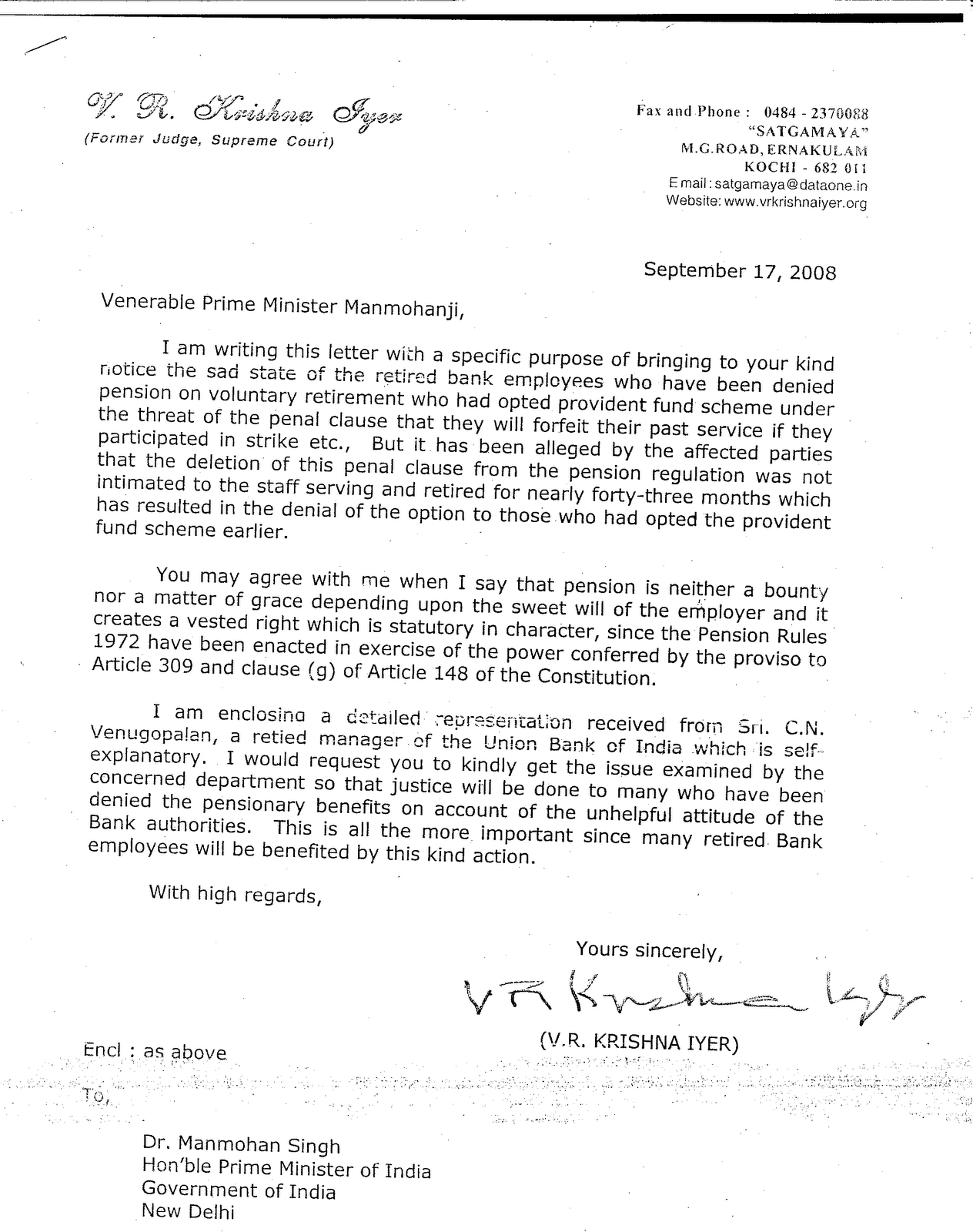
Letter to Prime Minister ( Recommended by Former Judge of Supreme Court
C N Venugopalan
Ex-Manager, Union Bank of India &
Vice President UBI Retired officers’ Association (Kerala)
Nandanam
Kesari Junction,
N Parvoor,
Kerala – 683 513
Phone. 0484 2447994 Mob: 9447747994 E-Mail: ceeyenvee@gmail.com
No. 20080916 16th September, 2008
Hon’ble Prime Minister of India,
Office of the Prime Minister,
Government of India,
Parliament Street,
New Delhi – 110 001
Respected Sir,
Denial of pension to majority of bank employees including me –
I was working as Officer MMJS-II in Union Bank of India with employee No. 028506 and I retired through Voluntary Retirement Scheme, 2001 on 20th April, 2001 after putting in 30 years of service in the Bank sans Pension benefit.
I had appraised you the injustice the Banking Industry meted out by denying Pension to a number of retired employees like me vide my letter dated 10th January, 2007. I regret to note that although your office was kind enough to forward my letter to the Secretary, Financial Sector, Ministry of Finance vide letter. PMO No ID No. 09/ 3 / 2007-PMP-4/750170 dated 22-JAN-2007, it received scant attention and no outcome has arisen. Whereas pension is not a new benefit to be given but is a benefit already granted by the Government in 1995 to employees, the denial of the benefit has arisen only through the wrong, illegal and whimsical implementation of the scheme.
Pension scheme on the lines available to central government employees was sanctioned in Banks in 1995. CPF scheme simultaneously continued for making available the existing benefit to those who could not secure prescribed minimum service of 20 years. Majority of employees are outside Pension Scheme now as a result of faulty and unlawful implementation of the scheme. Draft Pension Regulations published as also the final Regulations sanctioned by the Central Government called for options to be exercised within a prescribed date. When Final Regulations, contained a harsh clause enabling banks to forfeit the entire past services of an employee for participation in strike, (in variance from the draft regulations), many who opted earlier wished to come out and others who had not opted in terms of the draft did not join for fear of losing CPF and Pension if bank forfeited past service. Later, when the harsh clause was deleted from the Regulations on 27th February, 1999 following trade union pressure, options of those who took exit were not reinstated and others who had not opted on account of its infusion in final Regulations were not given fresh option. The amendment without specifying any effective date has effect from the inception of the scheme and the variation in offer terms vested with all a right to fresh option. Yet banks flouted fundamental principles of law and natural justice and did not give fresh chance of option. Banks thus meted out gross injustice to majority of bank men by denying Pension, the only source of income on cessation of employment and a right akin to fundamental rights of an employee.
Banks that usually circulated all amendments for information of employees before publishing in gazette kept the particular amendment in dark for enormously long time of 43 months and afterwards circulated it in a casual and stealthy way without taking individual acknowledgement as per practice in force. In Union Bank of India, the amendment of 27th February,1999 was published only on 8th October, 2002, after a time gap of 43 months. Many who retired in the meantime especially though VRS in April, 2001 had no information at all about it.
The scheme Government sanctioned contained no provision for revocation of an exercised option and had categorically stated that “an option, once exercised shall be final and irrevocable”. Yet, upon an advice from Indian Banks Association, (IBA) banks extended a chance and revoked options exercised in terms of the draft Regulations. IBA, a mere body of the bankers intercepted the authority of the Central Government by revoking the options exercised by the employees that were final in character. The revocation has taken place at the behest of IBA without taking previous sanction of the Government and without the Boards of Banks amending the regulations suitably. The process is null and void as IBA can not supersede the Central Government and / or the Board of the bank that adopted the Regulations. Even assuming that the process of revocation was a valid one, it has taken place when the harsh clause for forfeiture of entire past service was infused in the final regulations and the options had to be reinstated when the particular clause was deleted.
In short, those who had revoked their options and those who did not opt for the scheme when the harsh clause was inducted are having a legal right to get fresh option. Now it is strange that the Government is conducting feasibility studies for extending Pension Option as if it is a new benefit to be sanctioned. By not granting it in the original form to all those who have prescribed qualifying service, the Government and Banks are evading their own commitment to the employees and forcing them to agitate over the issue that is nearly a decade old one now.
The regulations did not have provision to pay pension before attaining the age of 60 and to employees with less than 20 years of service. However, Banks paid pension to such category that retired through VRS without enabling provisions. To escape accountability of unauthorized erroneous payments regulation 28 was amended on 13th July, 2002, reducing the qualifying service from 20 years to 15 years and vesting pension in premature retirement cases. This beneficial amendment too created an obligation for extension of fresh option especially to those who did not opt earlier.
Pension Scheme that took in its orbit all those who retired 9 years back from its inception by taking back the CPF paid on retirement and compulsorily encompassed all future recruits without any contribution from their side ironically denied the benefit to majority who were on the rolls at the time of inception of the scheme in 1995. Banks, whose profits contribute to the exchequer and partly meets the pension of government employees and statesmen, deny the benefit to their own employees by implementing pension scheme in a wrong way, flouting principles of law and natural justice.
Bank offices all over the country remained shut for three days during the last two years causing inconvenience to the public since Banks and IBA, drove the work force out of their seats on the issue of Pension Option. Another call for strike on September 24 & 25 is given by United Forum of bank Unions since the memorandum of understanding to resolve the issue within three months also is breached. Banking system is likely to get paralyzed once again. The blind trespass of bureaucracy into the pastures of simple and natural justice makes one feel that independence is a mirage even in the seventh decade of freedom.
I earnestly request you to intervene in the matter expeditiously and to direct the Ministry of Finance to examine details in the true perspective for rendering justice to all retired employees who are left in the lurch now by granting them the benefit of pension through proper implementation of the scheme in operation.
Thanking You,
Yours faithfully,
C N Venugopalan
Letter to T S NArayana Swamy, Chairman of IBA
C N Venugopalan
Ex- Manager, Union Bank of India
& Vice President, UBI Retired Officers’ Association (Kerala)
“Nandanam”
Kesari Junction
North Paravoor
Kerala – 683 513
Phone No. 0484 2447994 Mobile: 9447747994
Shri. T S Narayana Swamy, 3rd July, 2008
Chairman,
Indian Banks’ Association,
Block No. 2 & 3,
6th Floor, Stadium House,
81-83, V N Road,
Mumbai – 400 020
Respected Sir,
Congratulations!
I am delighted to hear that you have been enthroned as the Chairman of the Indian Banks Association vesting with you good opportunity to make it a meaningful organization that will meet its laudable objectives. Whereas it has lost its relevance as a progressive body, the task of resurrecting its eroded fundamentals is a formidable one. But I am sure your deft hands will find it an easy task to restore it glory by correcting past sins. Being an ex Unionite, it is my pleasure and duty to wish you all success and glory in the new assignment of making IBA a vibrant organisation.
In Union Bank, I succeeded Shri. P G Prasannakumar, Branch Manager at Vandiperyar in Idukki District controlled by Thiruvananthapuram Region you looked after in Kerala. After working in about seven branches as Branch Manager, I retired through "V R S" at the age of 50. Probably, you may not remember my name since I was a silent member in the family.
Past sins of IBA include several things that do not conform to any logical standards. Members of IBA had been quite unethical in business matters. Standing under the common umbrella of IBA, member banks were
pulling the legs of one other and snatching away the business of their own counterparts, using the lethal weapon of "interest rates" debilitating the banking system. Even the public sector banks themselves competed with each other and brought about serious financial loss to banking system in the scenario of deregulated interest rates. Take-over mania swept the banking system during 2004-2006 draining the profits and profitability. The resultant Loss was immeasurable. Reserve Bank of India remained to be Reverse Bank of India with no role in it. The beneficiaries of the foul game were potent people while deserving poor did not get any. Vehement criticisms I leveled against the unhealthy competition aimed at cheap cosmetics of the key men, put an end to take- over mania by August, 2006 and banks started posing excellent working results since the latter half of 2006-2007. About 10 to 20 percent of the interest income of the banks in India can reasonably be attributed to my work done, remaining outside of the banking system
It was ironical that banks that could afford such big loss of a heavy magnitude, banks that can bear the brunt of write-off to defaulters in the name of agricultural debt relief for pleasing the political masters, banks that can spend thousands of crores for changing a logo plead paucity of funds to pay pension to those who toiled for years together to make Banks what they are now. They have been adopting mean methods to avoid the legitimate dues of the work force in the industry. At the same time, the profits banks make, go to pay pension to government servants and to politicians who serve terms of 2 years and above in Parliament or Assembly. Banks chose to feed the neighbor's baby, putting their own babies to starvation. Banks compelled the employees to exercise option for pension, keeping in the
Regulations a clause enabling forfeiture of entire past service for participation in strike. On deletion of the clause on 27th February, 1999, they illegally acted and did not extend a fresh chance of option and moreover kept the amendment in camera by not circulating the amendment and by confining it to gazette publication. The regulations – draft and final- stated that option once exercised is final and irrevocable. Finally, they stated that IBA advised them to extend a chance for revocation of option exercised by an employee for any reason. They revoked the options at the behest of IBA when the Pension Regulations that were formulated in consultation with RBI and carried the previous sanction of the Central Government never had a provision for revocation of the options, which were final and irrevocable in nature. The process of revocation contemplated is illegal and founded on utter foolishness.
IBA has all along been taking double standard in the matter of compensating SBI staff and the rest of the bank employees by signing separate wage pacts for the two categories. In the matter of terminal benefits also, SBI staff have three benefits viz. PF, Gratuity and Pension as against Gratuity and / or PF in other banks. These are acts opposed to principles of equity and equality enshrined in the Constitution of India. Now that you have taken charge as Chairman of IBA, I implore that the illogical things looming large in the scenario may be eradicated to set IBA on a firm footing and to make the organization worthy of its name. As the talks on extending second option on Pension are reaching a final stage, I sincerely desire that you will use your wisdom and with your humane nature set right all anomalies and deliver justice to the entire banking community. I am eagerly watching to see the swift transformation of IBA under your eminent leadership from a bedlam into a responsible organization committed to the welfare of the bank men also while targeting higher goals of uplifting the entire nation.
With all good wishes and best regards, I remain.
Yours sincerely,
C N Venugopalan
Ex- Manager, Union Bank of India
& Vice President, UBI Retired Officers’ Association (Kerala)
“Nandanam”
Kesari Junction
North Paravoor
Kerala – 683 513
Phone No. 0484 2447994 Mobile: 9447747994
Shri. T S Narayana Swamy, 3rd July, 2008
Chairman,
Indian Banks’ Association,
Block No. 2 & 3,
6th Floor, Stadium House,
81-83, V N Road,
Mumbai – 400 020
Respected Sir,
Congratulations!
I am delighted to hear that you have been enthroned as the Chairman of the Indian Banks Association vesting with you good opportunity to make it a meaningful organization that will meet its laudable objectives. Whereas it has lost its relevance as a progressive body, the task of resurrecting its eroded fundamentals is a formidable one. But I am sure your deft hands will find it an easy task to restore it glory by correcting past sins. Being an ex Unionite, it is my pleasure and duty to wish you all success and glory in the new assignment of making IBA a vibrant organisation.
In Union Bank, I succeeded Shri. P G Prasannakumar, Branch Manager at Vandiperyar in Idukki District controlled by Thiruvananthapuram Region you looked after in Kerala. After working in about seven branches as Branch Manager, I retired through "V R S" at the age of 50. Probably, you may not remember my name since I was a silent member in the family.
Past sins of IBA include several things that do not conform to any logical standards. Members of IBA had been quite unethical in business matters. Standing under the common umbrella of IBA, member banks were
pulling the legs of one other and snatching away the business of their own counterparts, using the lethal weapon of "interest rates" debilitating the banking system. Even the public sector banks themselves competed with each other and brought about serious financial loss to banking system in the scenario of deregulated interest rates. Take-over mania swept the banking system during 2004-2006 draining the profits and profitability. The resultant Loss was immeasurable. Reserve Bank of India remained to be Reverse Bank of India with no role in it. The beneficiaries of the foul game were potent people while deserving poor did not get any. Vehement criticisms I leveled against the unhealthy competition aimed at cheap cosmetics of the key men, put an end to take- over mania by August, 2006 and banks started posing excellent working results since the latter half of 2006-2007. About 10 to 20 percent of the interest income of the banks in India can reasonably be attributed to my work done, remaining outside of the banking system
It was ironical that banks that could afford such big loss of a heavy magnitude, banks that can bear the brunt of write-off to defaulters in the name of agricultural debt relief for pleasing the political masters, banks that can spend thousands of crores for changing a logo plead paucity of funds to pay pension to those who toiled for years together to make Banks what they are now. They have been adopting mean methods to avoid the legitimate dues of the work force in the industry. At the same time, the profits banks make, go to pay pension to government servants and to politicians who serve terms of 2 years and above in Parliament or Assembly. Banks chose to feed the neighbor's baby, putting their own babies to starvation. Banks compelled the employees to exercise option for pension, keeping in the
Regulations a clause enabling forfeiture of entire past service for participation in strike. On deletion of the clause on 27th February, 1999, they illegally acted and did not extend a fresh chance of option and moreover kept the amendment in camera by not circulating the amendment and by confining it to gazette publication. The regulations – draft and final- stated that option once exercised is final and irrevocable. Finally, they stated that IBA advised them to extend a chance for revocation of option exercised by an employee for any reason. They revoked the options at the behest of IBA when the Pension Regulations that were formulated in consultation with RBI and carried the previous sanction of the Central Government never had a provision for revocation of the options, which were final and irrevocable in nature. The process of revocation contemplated is illegal and founded on utter foolishness.
IBA has all along been taking double standard in the matter of compensating SBI staff and the rest of the bank employees by signing separate wage pacts for the two categories. In the matter of terminal benefits also, SBI staff have three benefits viz. PF, Gratuity and Pension as against Gratuity and / or PF in other banks. These are acts opposed to principles of equity and equality enshrined in the Constitution of India. Now that you have taken charge as Chairman of IBA, I implore that the illogical things looming large in the scenario may be eradicated to set IBA on a firm footing and to make the organization worthy of its name. As the talks on extending second option on Pension are reaching a final stage, I sincerely desire that you will use your wisdom and with your humane nature set right all anomalies and deliver justice to the entire banking community. I am eagerly watching to see the swift transformation of IBA under your eminent leadership from a bedlam into a responsible organization committed to the welfare of the bank men also while targeting higher goals of uplifting the entire nation.
With all good wishes and best regards, I remain.
Yours sincerely,
C N Venugopalan
ACTUARIAL EXERCISE ON PENSION
C N Venugopalan
Ex- Manager, Union Bank of India &
Vice President, Union Bank of India Retired Officers’ Association (Kerala)
“ Nandanam”
Kesari Junction
North Paravoor
Kerala – 683 513
Phone No. 0484 2447994 Mobile: 9447747994 e-mail: ceeyenvee@gmail.com
Shri. M B N Rao, 26th April, 2008
Chairman,
Indian Banks Association, For kind personal attention
Mumbai,
Dear Shri. Rao,
Actuarial exercise on Pension
Children, smelling defeat while playing, resort to playing foul, violating all ground rules to spoil the entire game. Among the elderly, scoundrels playing the game of cards insert fake cards and win the game without the opponent seeing the mischief. If at all found out, they use muscle power and run away with the bet money. The banking dignitaries are not far from such people and act sans dignity while dealing with pension related issues. They ignore or violate cardinal rules and ethics, play foul and take shelter under power of purse and authority. They break the Regulations which they themselves made and behave like people sans self respect.
I am sorry to note that you have not cared to respond to any of my letters sent to you in your capacity as the Chairman of IBA and also personally for the simple reason that you do not have any justification to offer in respect of the absurdities and mistakes the IBA has committed while implementing schemes like VRS and while paying unauthorized pension to several people - it paid superannuation pension payable on attaining the age of 60 much before that to VRS retirees without Pension Regulations containing an enabling provision and subsequently amended Regulation 28 with retrospective effect to escape the accountability of wrong payment - and at the same time refusing Pension to several others who have the qualifying period of service to be eligible for pension and are legally entitled to it .
The IBA is again attempting to engender fresh issues that will precipitate while going on examining feasibility of extending second option on Pension with reduced benefits than what is extended originally. Fresh actuarial valuation is insignificant altogether since all those in service of the banks in 1995 are entitled to fresh option in the wake of the February, 1999 amendment to Regulations. Banks at that time, torpedoed all legal principles, kept the target group uninformed by publishing it in the gazette alone, contravening the usual practice of circulating in English and Hindi through appropriate internal communication.
Likewise, while reckoning the qualifying service, the grace period of five years to be added to actual number of years of service as provided in the Pension Regulations was not allowed to VRS retirees in several banks though the terms of offer of VRS originally stated that Pension would be payable as per Pension regulations to those retiring through it. The offer was amended at the fag end of the offer period of VRS without giving an opportunity to the subscribers to withdraw subscription to VRS.
In Union Bank, during the Leeladhar Regime, the gratuity was paid in two instalments to VRS retirees. It was not the first time employees were retiring from the Bank so as to get the payment vitiated by a mistake. On bringing the matter to his notice, the Chief Executive embraced stupendous stupidity driving the employees to external agencies for corrigendum action. Ultimate result proved that the Bank had defrauded and consumed the sweat of the brows of those who had partnered with it in its growth. The amount was to the tune of Rs.600 Crores which the Bank embezzled from its own people who went out co-operating with the management that wanted to trim its size. Such illustrious deeds elevated its architect to the present position and provide inspiration and motivation to career oriented people to follow suit for achieving their goals.
The mischievous acts the dignitaries in the elite banking circles have committed would take to shame even scoundrels. Recently there was a press report about the Chairman of a PSB, upon reading an earlier report of an auto driver returning to the owner the articles he had forgotten in his cab, relaxing the margin norms and granting an auto rickshaw loan. If the auto driver comes to know that the banker is one who has deceived his own people who worked for the bank by not granting them their eligible pension, he would perhaps refuse the gift altogether.
The comforts they enjoy while staying in star hotels most often and elite living conditions must have made the bank executives forget the past entirely and think that others are also comfortable. Ageing does not bring in wisdom but contracts cataract to impair their vision instead of broadening it. An attempt to step into the shoes of a person who is denied his legitimate pension, which is the only means of living at the fag end of his life, may open the vistas of mind.
Instead of carrying out the legal obligation to extend fresh Pension option in the original form it was extended earlier. IBA is now conducting an actuarial exercise. In order that such an exercise shall be meaningful to some extent at least, in respect of those who are already in Pension stream, banks should contribute to the pension Fund an amount equivalent to what is held in the employee’s share of compulsory PF minus what has been transferred into the Pension Fund earlier, in 1995. In respect of those who retired already, the contributions till date of retirement minus what is transferred initially should be transferred. The Pension Funds will definitely have surplus after meeting all Pension obligations as the compulsory employees’ contribution to PF of all the fresh entrants to Pension will also augment the Pension Funds of banks significantly for meeting all pension obligations with ease and comfort..
Banks and IBA appear as not led by logic or reason and find money to squander in so many ways. They take the command of the political masters and stand in a line as obedient dogs for getting favours. Interest free loans to sugar sector and waiver of agricultural loans for poll prospects meet with their approval when they plead paucity of funds for basic items like Pension. The bankers who stand below the common umbrella of IBA pulled legs of each other for snatching away the business of counterparts, using the dreaded weapon of reduced interest rate debilitating the individual banks. Vital fluid of banks oozed out in thousands of kilo litres enfeebling the entire banking system. The vehement criticisms I put forth put an end to the brisk interest war in the latter half of 2006-2007. Ten to twenty percent of interest income banks generate now can reasonably be attributed as my contribution made to the banking system remaining outside it and without being remunerated and the key men who have been enjoying fat remuneration were dwindling the resources for their cosmetics of business promotion. It is only after making fantastic contributions and after strengthening the system that I am pleading for justice to grant me my Pension, a legitimate due, which is not a charity doled out to a retired employee at the sweet will of the employer.
What I appeal to you is that:
Decisions should be dictated by what’s right and not by what it might cost us to do what’s right. Don’t let mistakes and failings take you prisoner. Ask God for fresh inspiration and wings of faith to help you rise above them.
We are all dignified people who call as “father” the person who engendered us. It is our benign responsibility to honour all commits we made. Let our deeds reflect our quality. We are people who enforce substantive law with full vigor against bank defaulters. Let us not be defaulters before the same law that enables us to perform our roles. Let us correct all past mistakes that have come to our notice and not stick on to them on grounds that are not tenable. Let bankers not be cowards and moral bankrupts for doing the right. I B A should strive to be worthy of being called Indian Banks Association to protect the interest of the bankers lest fellow bankers may think in terms of calling it “Indian Bastards Association”. If you imagine yourself in my place for a while, you will be able to easily grasp my strong feelings in the matter and I am sure you will initiate swift befitting corrigendum action. Let us not attempt to patch holes with darkness. Let us grant Pension option with retrospective effect to all those who have the prescribed qualifying service (including the notional grace period) and strictly as per our own Pension Regulations. Let qualifying service be the criterion and not the mode of exit, especially when the latter is formulated by the bankers themselves for their advantage. Let us not waste time as time is precious and important.
Thanking You,
Yours faithfully,
C N Venugopalan
M B N RAO Chairman IBA- Second Letter
C N Venugopalan
Ex- Manager, Union Bank of India
“ Nandanam”
Kesari Junction
North Paravoor
Kerala – 683 513
Phone No. 0484 2447994 Mobile: 9447747994
PEN IBA :124
31st October, 2007
The Chairman,
Indian Banks Association,
For Personal Attention of Shri M B N Rao
Mumbai
Dear Sir,
This has reference to my letter dated 14th September, 2007 captioned “Be on terra firma, Bankers” I sent to you, the reply of which is still awaited. It appears that you have nothing to contradict on any of the observations I made in it pervasively on the pension related issues in Banks. Banks still have to cultivate a good and rich tradition of establishing fairness in all areas of operation and to set a model before other segments of business and industry in tandem with the rich tradition of the country.
I have to be a spokesman of the retired people more than of those now working and hence I stress the need for extending Pension benefit to all who have gone out through VRS and other schemes. When one section that went out through VRS is getting Pension, the left out people who have made the same contribution to the industry ought to be treated on par. It is not the modus of exit, but the qualifying service stipulated as per the Pension Regulations that matters. Any corrigendum action without containing the element of jurisprudence to the full extent will be a lame action that will perpetuate injustice again.
It appears that the industry is seized of the need for extending a second option by extending the scheme in its original form to those who did not exercise the option on account of the existence of the deleted clause (relating to forfeiture of past service for participation in strike). If so there is no point in dilly-dallying the matter by examining the actuarial aspects. Banks will become richer, morally and financially as can be judged from the fantastic working results, individual units are making now. As I said earlier, implementation of the scheme will not cost anything more to the industry and the expenditure can be contained within the level of expenditure obtaining in 1995. What is required is only a positive approach to the issue.
I trust, the matter is amply clarified. I expect to hear from you a line in reply, in case you do not concur fully with any of my observations.
Thanking You,
Yours faithfully,
C N Venugopalan
Ex- Manager, Union Bank of India
“ Nandanam”
Kesari Junction
North Paravoor
Kerala – 683 513
Phone No. 0484 2447994 Mobile: 9447747994
PEN IBA :124
31st October, 2007
The Chairman,
Indian Banks Association,
For Personal Attention of Shri M B N Rao
Mumbai
Dear Sir,
This has reference to my letter dated 14th September, 2007 captioned “Be on terra firma, Bankers” I sent to you, the reply of which is still awaited. It appears that you have nothing to contradict on any of the observations I made in it pervasively on the pension related issues in Banks. Banks still have to cultivate a good and rich tradition of establishing fairness in all areas of operation and to set a model before other segments of business and industry in tandem with the rich tradition of the country.
I have to be a spokesman of the retired people more than of those now working and hence I stress the need for extending Pension benefit to all who have gone out through VRS and other schemes. When one section that went out through VRS is getting Pension, the left out people who have made the same contribution to the industry ought to be treated on par. It is not the modus of exit, but the qualifying service stipulated as per the Pension Regulations that matters. Any corrigendum action without containing the element of jurisprudence to the full extent will be a lame action that will perpetuate injustice again.
It appears that the industry is seized of the need for extending a second option by extending the scheme in its original form to those who did not exercise the option on account of the existence of the deleted clause (relating to forfeiture of past service for participation in strike). If so there is no point in dilly-dallying the matter by examining the actuarial aspects. Banks will become richer, morally and financially as can be judged from the fantastic working results, individual units are making now. As I said earlier, implementation of the scheme will not cost anything more to the industry and the expenditure can be contained within the level of expenditure obtaining in 1995. What is required is only a positive approach to the issue.
I trust, the matter is amply clarified. I expect to hear from you a line in reply, in case you do not concur fully with any of my observations.
Thanking You,
Yours faithfully,
C N Venugopalan
Subscribe to:
Posts (Atom)
